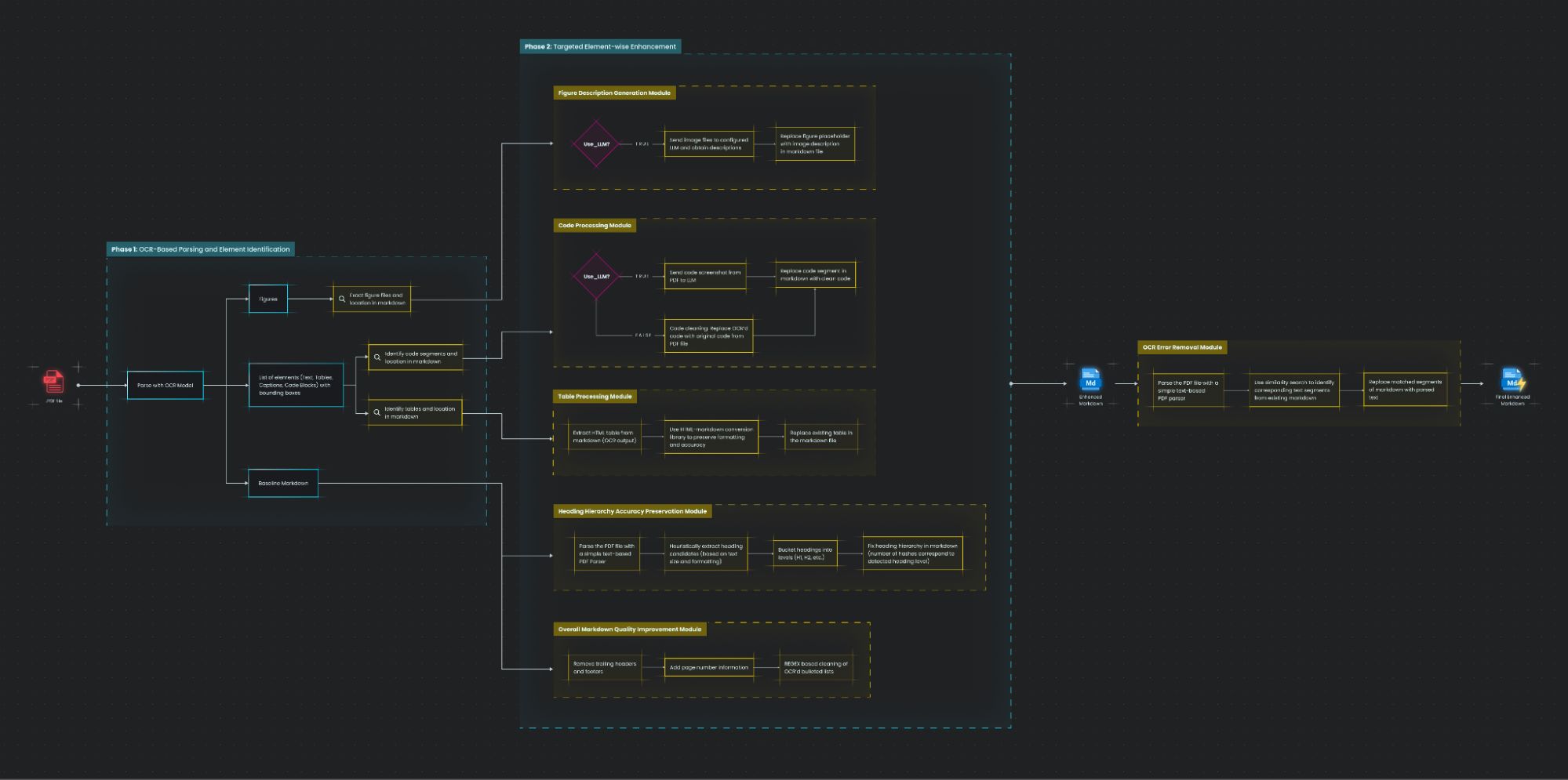
GenieParse parses the document once, applies targeted element-level enhancements, and finishes with a dedicated OCR cleanup pass.
GenieParse was developed by Genie, Emumba’s dedicated GenAI R&D group.
Bad PDF parsing breaks document intelligence.
A parser can extract every word from a document and still lose the information that matters: heading hierarchy, reading order, table structure, code formatting, figures, and the relationships between them.
For RAG, enterprise search, and agentic document Q&A, these are not cosmetic details. They determine what the system can retrieve and how accurately an LLM can reason over it.
That is why we built GenieParse, and why we are now releasing it as open source.
Explore the code: github.com/Genie-Experiments/pdf-parsing
Most parsing tools attempt to solve the entire document in one pass. GenieParse takes a different approach.
It begins with ByteDance’s Dolphin model to generate baseline Markdown and identify document elements with their locations. It then applies targeted processing to the areas where general-purpose parsers commonly fail:
Reconstructing the correct heading hierarchy
Converting OCR-generated tables into cleaner Markdown
Recovering and fencing code blocks
Extracting figures and optionally generating descriptions
Removing repeated headers and footers
Standardizing lists and page boundaries
Replacing OCR-corrupted text with cleaner text extracted directly from the PDF
The result is a more structured and usable representation of the original document.
GenieParse parses the document once, applies targeted element-level enhancements, and finishes with a dedicated OCR cleanup pass.
A major advantage of this architecture is control.
GenieParse does not send every page of every document through a state-of-the-art vision LLM. Most of the pipeline uses the base parsing model, direct text extraction, heuristics, and deterministic post-processing.
LLM-based enhancement can be enabled selectively for:
Describing figures
Recovering difficult code blocks
It is disabled by default.
This keeps API costs low and predictable while allowing teams to use a stronger model only where it adds clear value. It also makes the pipeline easier to adapt for private or cost-sensitive environments.
Before releasing GenieParse, we compared it with six other parsing tools, including open-source parsers and commercial cloud services.
The focused benchmark covered financial reports, hardware documentation, installation guides, CLI-heavy documents, and an academic paper. Each parser was evaluated across text, hierarchy, reading order, tables, images, code, captions, and mathematical notation.
GenieParse ranked first overall with a score of 88.6. The next-highest tool, LlamaParse, scored 80.9.
GenieParse achieved particularly strong results in:
Reading order: 97%
Image extraction: 96.2%
Code blocks: 95%
Heading hierarchy: 89.8%
It did not win every individual category. Other tools performed better on some tables, text extraction, and mathematical notation. However, GenieParse was the most consistent across the document elements that mattered collectively.
This was a focused test across five deliberately varied documents—not a claim that we have covered every document type or parser configuration. The more important result is that a configurable pipeline with targeted fixes outperformed every unmodified tool we tested on average.
GenieParse can be used in two ways.
The standalone CLI processes individual PDFs or entire directories locally, without requiring Docker, Postgres, or Redis.
The full-stack application adds:
Browser-based PDF uploads
Live processing logs
Job history
PDF-to-Markdown region navigation
Downloadable Markdown output
CPU and NVIDIA GPU deployment options
The repository includes the core pipeline, FastAPI backend, worker infrastructure, Next.js frontend, Docker configuration, and sample documents.
GenieParse reflects a principle we have seen repeatedly in our R&D work:
Document parsing is not a utility step. It is an engineering layer that directly affects downstream AI quality.
A generic parser may be enough for clean, simple documents. Complex enterprise PDFs often require more control.
GenieParse provides that control in an open, modular pipeline—while letting teams decide where advanced models are worth using and where deterministic processing is enough.
The project is open source and ready to explore:
Get GenieParse on GitHub