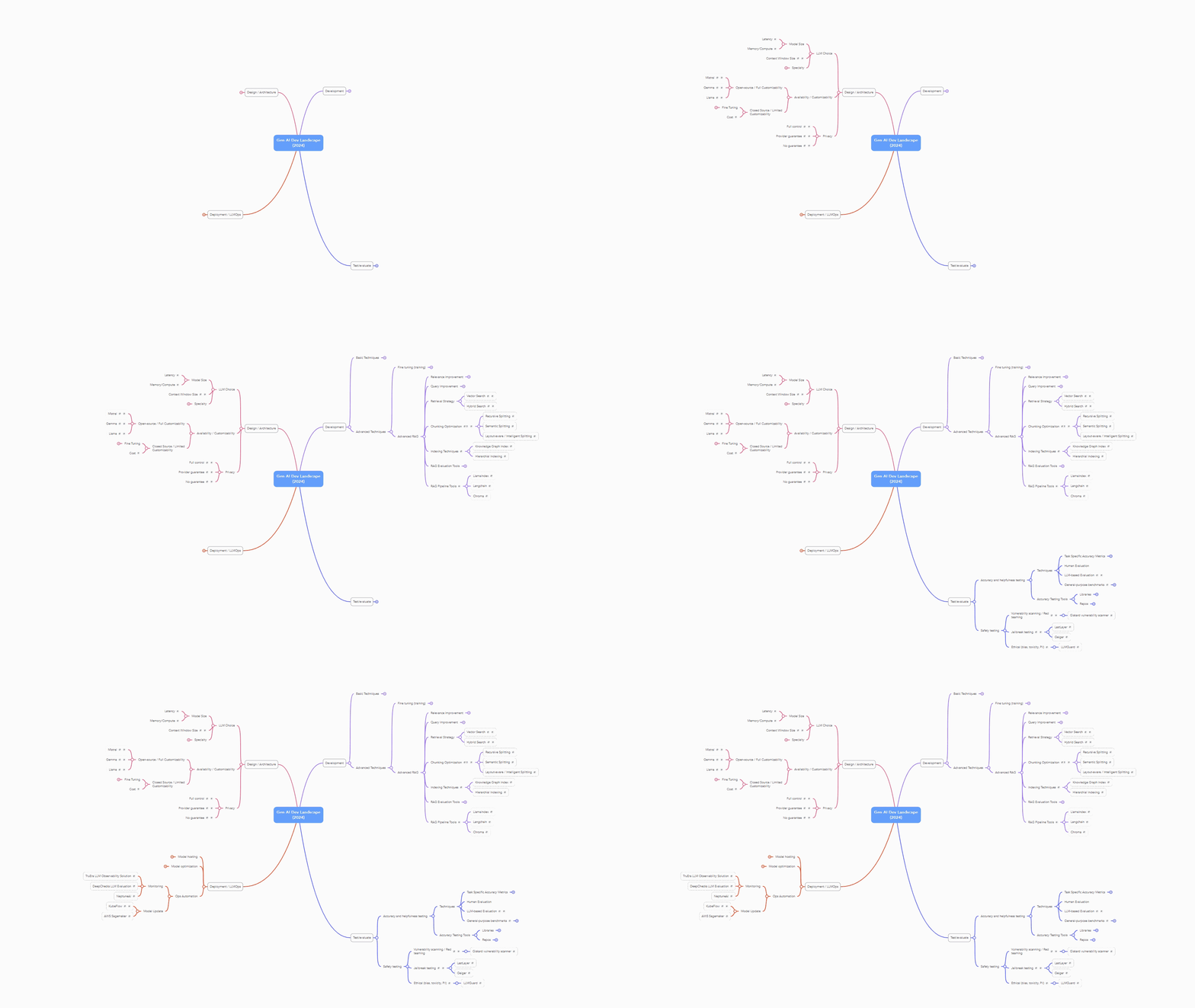
The Genie mind map with drill-down ability.
The original post below released the first version of a GenAI application development landscape mind map (2024). The landscape has matured significantly since, and how we develop GenAI applications has changed. We have now released a new 2026 version hosted here: https://geniemindmap2026.netlify.app/
The latest version is still organised like the original along the stages of the SDLC, as it is meant to be an aid to dev teams building GenAI applications, but is massively updated with all the latest and greatest developments in the domain. Primarily, the design & development section (now merged) is now organised in terms of core GenAI capabilities (such as model invocation, tool use and so on) that form the core components of any GenAI application. This is so that it is generic and applicable to any type of GenAI application. Within each capability, you can interactively drill down and explore the tools, techniques and key concepts you need to be aware of when building with that capability.
The evaluation section is organized to mirror how well-functioning teams actually test GenAI systems: first by what you're trying to measure (strategy, accuracy, performance, safety), then within accuracy, by which capability you're evaluating.
Finally, operations is concerned with running GenAI in production: where models and tools run, how you observe them, and how you control cost and capacity.
View the updated mind map here: https://geniemindmap2026.netlify.app/
The advent of generative AI (GenAI) has brought about a paradigm shift that is changing the way we design, develop, and deploy software. It has become essential for development teams to adapt to this new reality.
GenAI introduces a new modality for development by integrating large language models (LLMs) and advanced AI, alongside new tools and techniques. However, this shift is not merely about adopting new tools. While the software development lifecycle (SDLC) stages — planning, design, development, testing, deployment, and maintenance — remain the same, each step now requires new and unique skills and techniques.
Development teams face two core challenges in navigating this new age, especially when developing GenAI solutions. First, a rapidly evolving landscape where new algorithms, techniques, companies and models appear at a dizzying pace. Second, the hype around these new, often seemingly overlapping, options causes significant confusion on what approach is best to achieve a specific requirement.
We, at Emumba, felt a need for a structured framework that helps us — as providers of bespoke GenAI service — navigate the landscape of GenAI while building solutions in this exciting new space.
This mind map (note: it is live and evolving) is an output from the Genie (short for GenAI@Emumba) group to R&D and navigate the GenAI terrain. We read, experimented and leveraged our customer experience to map tools and techniques to the different stages of design, development and deployment of GenAI applications. We are now releasing this mind map as a public resource for new entrants to this domain.
We view the benefit of our mind map to be two-fold:
First, it allows management a high-level view of the landscape when making strategic decisions regarding staffing and timelines for building teams or adding capacity for GenAI.
Second, with the ability to drill down, it acts as a strategic decision-making assistant for developers, architects, testers, and LLMOps professionals to execute the GenAI development process.
This map is not exhaustive. It is not meant to cover every tool or company in the space. Its real value lies in simplifying the landscape and providing a framework to slot in new developments as they emerge in a continuously evolving space.
This map focuses on text-based LLMs. Multi-modal or multi-agent systems are excluded to maintain focus on the core capabilities of text-based LLMs.
This map is not a learning roadmap. Although it can be used to derive one, it is not intended to be used as a substitute for a personalized learning plan.
This map is specific to GenAI development. To retain focus on the unique steps of GenAI development, techniques and tools common to classical software development are left out.
The Genie mind map with drill-down ability.
You can interact with the Genie mind map on Mind Meister here. The map opens in a textual Outline view by default. You can see the visual view above by clicking Mind Map from the controls at the bottom left.
Note: Currently the Mind Map view is optimised only for desktop display.
Our mind map aids decision-making throughout various development stages by organising along the standard software development stages: design, development, testing, deployment, and maintenance.
Relevant tools are incorporated wherever possible, linked to applicable techniques. Tools appear as child nodes of specific techniques (indicating a one-to-one relationship) or parallel to technique nodes (indicating implementation of multiple techniques in one tool).
Pay special attention to nodes with dotted outlines (visible only in the Mind Map view). These represent non-exhaustive lists, meaning there are additional options available beyond those explicitly shown. While most tool nodes have dotted outlines due to the vastness of the tooling landscape, some technique nodes may also be dotted, signalling that the field is broader than what is presented.
Design / Architecture
The design / architecture section of the mind map covers the critical decisions a Software Architect will need to make at the beginning of a project, including selecting the LLM, choosing between open vs. closed-source models, and deciding between external providers or self-hosting options.
Development
In the GenAI space, the development role is perhaps the most complex and rapidly evolving. Therefore, it is the central focus of our mind map. We have organised this stage in increasing order of complexity. A developer will usually start at the top with basic techniques to quickly create a simple working example. However, in more complex or innovative use cases, the developer will need to adjust the more intricate knobs under “advanced techniques”. These include fine-tuning and advanced methods for retrieval augmented generation.
Note: Advanced RAG is a vast area with numerous tools and techniques for each stage of the process and will be covered in more depth in a separate, specialised taxonomy that we are currently developing.
Testing
The mind map divides the testing stage into two categories: accuracy and safety. Accuracy tests, also known as helpfulness tests, aim to evaluate the functional performance of the LLM application. Safety tests consider ethical, privacy, and security concerns. Various relevant tools are linked to each technique, and more comprehensive tools covering multiple techniques are linked in a separate node.
Deployment and LLMOps
Like any solution, hosting and production deployment of GenAI solutions has unique avenues of exploration. We outline the two primary model hosting options for GenAI applications: SaaS vs. self-hosting. Both have significant implications for the application’s cost and latency. Other factors to consider for deployment include model optimisation (minimising model size while maintaining performance) and post-deployment operations. These involve monitoring safety, accuracy, and concept drift, as well as managing model updates.
GenAI has brought about a paradigm shift in software development, introducing new challenges and opportunities. We built a mind map that we believe will serve as a valuable resource for software architects, developers, testers, and other professionals involved in GenAI development. By leveraging this framework, organisations can navigate the rapidly evolving GenAI landscape and build innovative solutions that drive business value.