What We Learned by Putting Enterprise Policy Inside a Coding Harness

Sep 18, 2026
6 min read
AI-assisted development is moving into day-to-day software delivery, and coding harnesses are giving developers more autonomy over how that work gets done. Developers can choose the tools, models and workflows that fit their project, provide project-specific context, and adjust how the harness approaches a coding task. This flexibility is part of what makes these tools useful, especially because the needs of one project can be quite different from another.
The enterprise, however, remains accountable for outcomes that individual developers cannot manage independently. In practical terms, it needs:
Visibility into how AI-SDLC is being effective
Predictable costs
Privacy safeguards
Ability to streamline engineering processes across teams
These needs do not all imply the same kind of control. Some involve guidance that developers and teams should be able to adapt to their context. Others represent boundaries that need to be consistently enforced across the organization.
This leaves us with a tension between developer autonomy and enterprise accountability. A control that developers can disable cannot provide a strong enterprise guarantee. On the other hand, an enterprise control model that takes over the development workflow itself risks removing some of the flexibility that makes these harnesses valuable. The question is therefore not whether autonomy or control should win, but where the boundary between them should live.
Our experience: harness-local controls worked, but could not guarantee enforcement
Our first experiment tested whether an enterprise control could live inside the coding harness itself. We chose Pi.dev because it was open source and gave us the flexibility to modify it for our purpose. We built a routing extension into Pi that intercepted each developer request and automatically selected the cheapest capable model for it. The extension worked as intended, but its routing policy lived in local files on the developer’s system. Disabling it was as simple as removing those files from Pi’s startup configuration. If the extension was not loaded, the policy did not apply.
This failure gave us a narrower and more useful conclusion than simply saying that controls do not belong inside harnesses. Harness-local controls can still be useful, particularly when they need to interact closely with the harness. However, a policy that must remain in force across the organization cannot depend entirely on configuration that an individual developer controls.
The control boundary also needs to survive a change of harness
Enforcement was not the only limitation of our first approach. The routing layer we built was coupled specifically to Pi.dev, so it could not be used in the same form with Claude Code, Codex, OpenCode, or another harness adopted by the organization. The policy need was not specific to Pi: the enterprise wanted requests to be routed according to capability and cost. Its implementation, however, was tied to Pi’s extension model. Repeating this approach for every harness would leave the organization maintaining multiple implementations of what is essentially the same enterprise policy.
Some harness-specific integration will probably remain necessary. Different harnesses have different extension points, tool models and internal behavior, and we do not yet know how much control logic can realistically be shared across them. Still, the policy itself needs a more durable home than any one harness if it is expected to remain consistent as tools change.
Our proposal: control plane separation from the developer harness
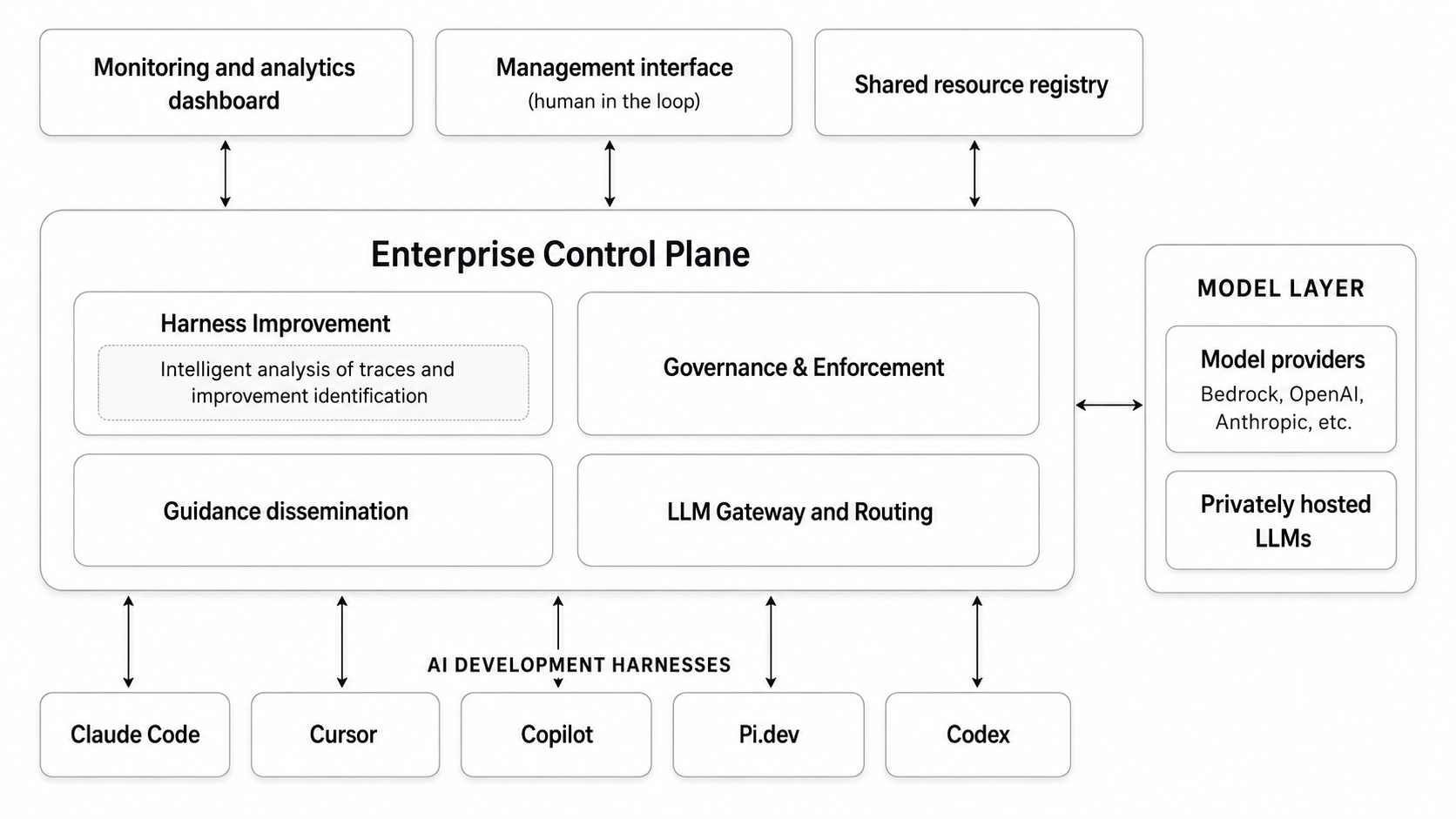
These two constraints led us to our current thesis: enterprise controls that must persist across developers and tools should live one layer above developer-controlled harnesses. The harness should continue to own its planning, tool use and other embedded logic for solving coding tasks. The enterprise layer should own the boundaries that need to remain consistent, such as model and provider access, credentials, budgets, privacy constraints, and organization-wide visibility. This division is intended to preserve developer autonomy within enterprise-defined boundaries, rather than move the entire development workflow under centralized control.
In the architecture we are exploring, this enterprise layer takes the form of a control plane to the developer harnesses (should we call it “dev-plane”?). Developers access coding models through the control plane, which acts as a proxy. This placement allows the control plane to mediate access, centralize credentials and budgets, and apply privacy or data-residency constraints. Potentially it could also be used to distribute shared guidance, govern access to external tools, and collect telemetry about usage of AI-assisted development.
This layer would not prevent developers from using entirely separate, unapproved tools that are not connected to the control plane. Some controls may also remain harness-specific, particularly where enforcement depends on the harness’s internal planning or tool-use behavior. The control plane therefore does not settle every part of the autonomy-versus-accountability boundary. It does, we believe, give us a good place to begin exploring it.
The control plane extends the gateway
The proposed control plane is not simply another name for an enterprise model gateway. Gateway products such as LiteLLM already provide capabilities around credentials, model access, routing and cost. Those capabilities would form an important part of the control plane, but they cover only the model-access layer of the problem.
The broader control plane builds on the gateway by adding governance, shared guidance and telemetry across the enterprise-provided AI development path. Its purpose is not only to decide which model receives a request, but also to make organizational policy and knowledge more consistent across the different harnesses used by development teams.
The guidance responsibility may have a longer-term value of its own. Skills, prompts and workflows increasingly capture how an organization wants work to be performed. They can contain domain knowledge, preferred engineering practices, review steps and other operational knowledge that the organization may consider part of its intellectual property. Keeping these resources in a centrally managed registry would make them easier to govern and more portable across harnesses and models. Potentially, to prevent that knowledge from being exposed to an external provider, the control plane could implement policies governing which resources can be sent to which models and under what data-handling constraints.
The boundary is clearer than the implementation
At this point, the boundary is clearer to us than the implementation. The enterprise needs ownership of controls that must remain consistent, while developers need room to adapt their harnesses and workflows to the work in front of them. A control plane around the harness appears to be a useful way of separating those responsibilities, but we do not yet know how consistently that separation can be implemented.
Some of the questions we are still exploring include:
Which controls can be enforced at the control plane, and which require integration with the harness itself?
How should shared guidance be distributed and updated without overriding project-specific knowledge?
What is the common telemetry between different harnesses, and is that sufficient for enterprise needs?
Will the boundary between harness-level and control-plane enforcement change from one harness to another?
What our Pi.dev experiment gave us evidence for was a relatively narrow conclusion: a policy that must hold cannot depend entirely on developer-controlled local configuration. It also showed us the maintenance problem created when enterprise policy is built specifically for one harness. It did not prove that every enterprise-control capability can be moved into a shared control plane.
That is what our next prototypes need to test. We expect some responsibilities to remain harness-specific and others to belong to systems the enterprise already uses. For now, the control plane is a working architectural hypothesis: a way to preserve developer autonomy while giving the enterprise a more durable place to enforce the boundaries for which it remains accountable.