When is Thinking of LLMs as Humans Not a Bad Idea?

May 15, 2025
8 min read
Introduction
Technological revolutions occur when foundational shifts fundamentally alter how systems are conceived and built. The invention of the microprocessor was one such pivotal moment, revolutionizing computing by enabling programmable, scalable, and deterministic automation, ultimately laying the groundwork for personal computing, software-driven logic, and modern digital infrastructure. Today, we are witnessing another transformative paradigm shift with the advent of Large Language Model (LLM)-based agents — systems capable of autonomous reasoning, dynamic inference, and adaptation.
This blog shares the opinion of why the introduction of LLMs as a computing artifact marks the beginning of a new paradigm. First, it clarifies how these systems differ fundamentally from traditional deterministic computing, emphasizing their ability to reason autonomously. Next, it introduces a helpful anthropomorphic analogy, mapping the experience and specialization of LLM-based agents to human expertise, offering practical guidance for their selection and integration. Finally, it then discusses how these evolve into collaborative multi-agent systems, mirroring modular design principles inspired by microservices, and explores how thoughtfully orchestrating these hybrid architectures — balancing autonomous cognition with deterministic logic — will shape the future of computing.
LLMs as New Computing Paradigm
Throughout history, fundamental changes in computing architecture have sparked technological revolutions. The invention of the microprocessor was precisely such a transformative event — because it profoundly changed how computation can be automated. Microprocessors automated mathematical operations within compact, programmable chips, enabling the creation of structured and deterministic software systems. This innovation was accelerated by advancements in chip design, and parallel growth in software tooling, resulting in a computing stack we have become accustomed to until late 2022.
LLMs being introduced as a computing artifact marks a similarly transformative moment. Unlike traditional software, which executes explicitly defined instructions, LLMs introduce dynamic reasoning, adaptive planning, and knowledge synthesis directly into software architectures. The emerging LLM-based development stack — consisting of agents, tools, frameworks, and platforms — is poised to unlock an entirely new universe of computing applications. This inflection point is likely similar to the one triggered by the co-evolution of microprocessors and their supporting development ecosystems in late 90s.
The future of computer system design will, thus, be driven by continued model growth and the effective integration and orchestration of these reasoning abilities within workflows, legacy software applications, and infrastructure. Much as modern computing depends on integrated software, memory, and networking rather than raw computational power alone, the transformative impact of LLM-based agents lies in their ability to become deeply embedded within digital architectures, redefining what it means for you to build a “software application”.
Human-Like Attributes of LLMs: Experience and Expertise
While the historical analogy of the microprocessor helps us appreciate the scale and impact of this computing shift, understanding its true potential for practical application requires a different framing. To fully grasp the possibilities and limitations of these cognitive systems, it’s useful to think of them not merely as sophisticated software components, but as human-like thinkers — entities characterized by experience, specialization, and collaborative intelligence. This anthropomorphic analogy provides us with intuitive language and practical guidance for selecting, designing, and orchestrating intelligent systems.
Note: This analogy is purely opinion based on my experiences at Emumba overseeing the development of GenAI features and products, but not grounded in any deep scientific rigor.
Thinking of LLMs as Humans!
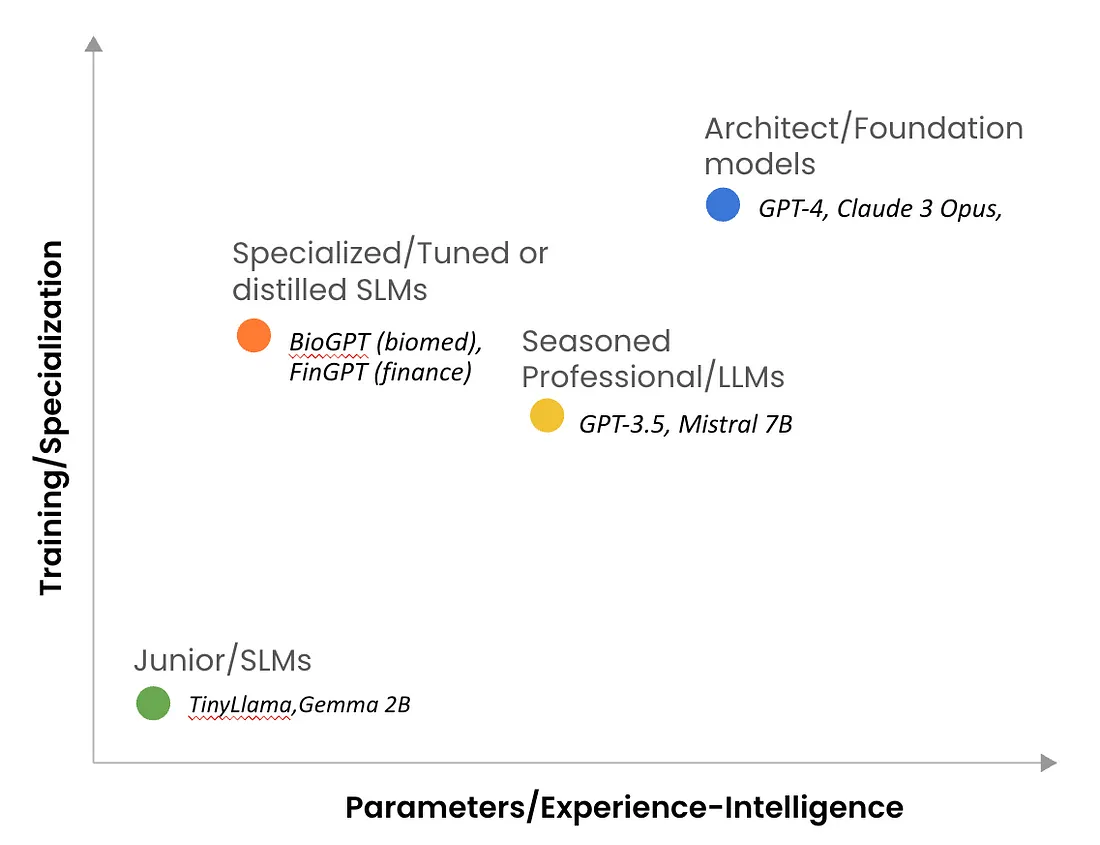
The first axis of this analogy relates to experience. Here, we propose that human experience is roughly analogous to parameter size. A model with a larger number of parameters behaves more like a seasoned expert: it brings a broader, more nuanced understanding, often yielding “gray-haired” responses — balanced, context-aware, and mature. Even when trained on the same data, a large LLM tends to produce insights that feel more refined, simply because its architecture allows for deeper abstraction and broader generalization. Parameter size, then, becomes a useful proxy for accumulated experiential depth.
The second axis focuses on specialization. In human terms, we gain expertise by immersing ourselves in a subject — through study, repetition, and practical application. LLMs exhibit a similar pattern through fine-tuning or task-specific training. A smaller model, with relatively few parameters, may lack the broad contextual intelligence of a large model, but when trained narrowly on a single domain, it can outperform larger models in focused tasks. This gives rise to a design spectrum — from generalist foundation models to small, domain-specific experts. It also explains the growing interest in tuning and distilling Small Language Models (SLMs), which trade generality for efficiency and target performance.
Taken together, these two axes — experience and specialization — create a conceptual space in which we can classify different types of LLMs. Specialization itself is multidimensional, spanning a wide range of domains and tasks. Foundation models, with high parameter counts and web-scale training data, sit in the upper-right of this space. These models are akin to polymath humans — capable across a range of disciplines. Fine-tuned SLMs, on the other hand, sit in the upper-left: narrow experts trained deeply in one domain. General-purpose LLMs map to seasoned professionals within a field, while small, broad models resemble junior contributors — capable, but needing direction.
Importantly, this analogy offers a useful design tool. It allows us to reason about which type of LLM to use when architecting solutions. Like choosing a team member for a specific role, selecting the right model involves balancing cost, availability, and complexity. Do we need broad judgment across ambiguous domains? Or a narrow, fast, and efficient expert? Are we optimizing for latency, licensing, or local inference? The human analogy gives us language to make these trade-offs tangible and purposeful in design conversations.
While standalone LLMs can reason impressively, their lack of memory and inability to retrieve greater context, limits contextual depth and continuity. This is where LLMs-based agents come in — wrapping LLMs with memory, tool integration, and multi-turn interaction logic. This transition mirrors how human intelligence becomes more effective when supported by memory aids, tools, and collaborative infrastructure. The addition of memory transforms a stateless responder into a persistent, evolving participant — enabling the leap from one-shot prompts to system-level cognitive workflows.
From Standalone LLMs to Multi-Agent AI Systems
As LLM-based agents mature, the next natural evolution is toward multi-agent systems — collections of specialized agents collaborating to solve complex tasks. The same principles of experience and specialization apply at the systems level, where agents with distinct focus areas and levels of expertise are orchestrated into cohesive, goal-driven teams, much like human teams. If a single agent is like a skilled professional, a multi-agent system is a well-structured team — each member contributing its unique capabilities toward a shared objective.
This mirrors the architectural philosophy of microservices. In well-designed systems, responsibilities are split across independent, domain-focused services that interact through clear contracts. The power of this approach lies not just in scalability, but in modularity, specialization, and the ability to evolve each part independently — principles that map cleanly to multi-agent GenAI design.
Rather than relying on a monolithic model to handle everything, we decompose intelligence into focused agents — retrievers, planners, synthesizers, validators — each contributing to the overall reasoning process. These systems are not just more scalable, but also more interpretable, because each agent has a well-defined role.
Frameworks like AutoGen, CrewAI, and Letta are already enabling this shift. They provide the primitives for composing agent workflows, managing context, and defining inter-agent coordination. Much like service orchestrators transformed microservices, these frameworks are transforming how we build AI-native architectures — not by scaling a single model, but by designing intelligent, modular systems of collaboration.
This shift from monolith to modularity — from solitary reasoning to orchestrated cognition — is more than just scaling. It demands that we move beyond deploying single models and start designing teams of agents, each specialized, each with a different capability level, yet collectively smarter and more capable than any individual component alone.
The Future Areas of GenAI System Design
Just as the invention of microprocessors eventually led to entirely new ecosystems — operating systems, distributed computing, and cloud platforms — the advent of LLM-based agents will drive the emergence of many interesting new opportunities. While growth in model size and performance remains important, equally compelling opportunities lie in how we integrate autonomous reasoning deeply within software, infrastructure, and intelligent workflows.
The real shift will occur as LLM-based agents move beyond external tools to become core components embedded directly into digital architectures. Just as human experts rely on supporting tools, structured processes, and collaboration frameworks, AI-native systems will embed cognition directly into workflows, applications, and infrastructure. Cloud platforms will evolve to orchestrate cognitive workloads dynamically, much as they currently distribute computational resources. These platforms will manage AI reasoning tasks at scale, continuously learning and adapting, just as humans do within dynamic teams.
Future systems will not be purely LLM-based; traditional software components and deterministic systems will persist where predictability is paramount. Designing effective systems thus requires creating hybrid architectures — carefully balancing autonomous cognition from agents with traditional rule-based logic. The analogy to human teams helps here again: just as effective organizations blend expert human judgment with structured processes and management, the next generation of software solutions will need to blend reasoning agents with deterministic guardrails and processes and effective management of these non-deterministic, reasoning, agents,
Conclusion
We stand at a transformational moment in computing, echoing the fundamental shift driven by the microprocessor. Just as microprocessors allowed us to automate deterministic tasks, LLM-based agents enable us to integrate autonomous reasoning directly into our system designs. Guided by the human-like attributes of experience and specialization, our future systems will be modular — carefully balancing powerful cognitive agents with traditional software components. The opportunity now is to lead — not just by deploying more sophisticated models tools, but by thoughtfully orchestrating intelligent, collaborative systems. Organizations that lean into this new paradigm will help shape not just the next generation of systems, but the future of how we think, work, and build together.